

Data helps educators make better decisions. As schools evaluate language programs, technology investments, and engagement strategies, three patterns emerge from the numbers: language access in U.S. schools remains uneven, digital tools have achieved enormous reach without matching conversion, and sustained practice is still the bottleneck between exposure and proficiency.
1. Enrollment & Access
- 5.3 million English learners were enrolled in U.S. public schools in fall 2021 — 10.6% of all public school students. (NCES, Condition of Education, May 2024)
- That is up from 4.6 million (9.4%) in fall 2011, roughly 15% growth across the decade. (NCES)
- The most recent Condition of Education puts the figure at 10.8%, continuing the upward trend. (NCES, 2025)
- Concentration varies enormously by state — from 0.8% in West Virginia to 20.2% in Texas — which is why national averages are close to useless for staffing decisions. (NCES, fall 2021)
- Approximately 20% of the U.S. K-12 population is enrolled in a foreign language course — about 10.6 million students, or one in five. (American Councils for International Education, National K-12 Foreign Language Enrollment Survey)
- Only 43% of U.S. public schools report offering world language classes at all, and just 20% of elementary schools. (ACTFL analysis of NCES School Pulse Panel, 2026)
The asymmetry is worth naming. The United States has one of the developed world’s weakest records on teaching second languages to English speakers, and simultaneously one of its fastest-growing populations of students acquiring English.
2. Technology & Engagement
- Duolingo reported 137.8 million monthly active users in Q1 2026. (Duolingo Q1 FY2026 shareholder letter)
- Daily active users reached 56.5 million, up 21% year over year — the first quarter above 55 million in company history. (same)
- The company crossed $1 billion in annual revenue for the first time in 2025, at $1.0376 billion. (Duolingo FY2025 results)
- Language learning apps as a category generated $1.54 billion in consumer spending in 2025, an 18.8% year-on-year increase. (Business of Apps, 2026)
- More than 10 million Duolingo users hold consecutive 365-day streaks. (Duolingo, early 2026)
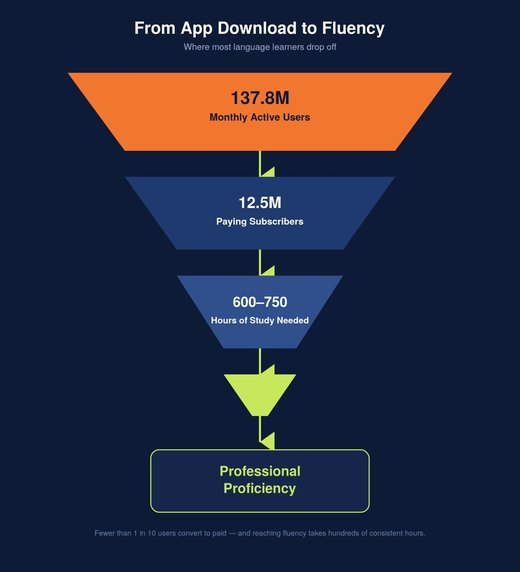
- And yet: the company ended Q1 2026 with 12.5 million paying subscribers against 137.8 million monthly actives — meaning roughly 91% of the largest platform’s user base has never paid it anything. (Duolingo Q1 FY2026)
“Statistic 12 is the one to sit with. Reach is not the industry’s problem. Conversion from curiosity to commitment is.”
3. Proficiency & Outcomes
- Reaching Professional Working Proficiency in Spanish takes an English speaker 600–750 classroom hours. (U.S. Foreign Service Institute)
- Spanish sits in the FSI’s easiest category. Mandarin, Arabic, Japanese and Korean require roughly 2,200 hours — more than triple. (U.S. FSI)
Set 13 against 11
A five-minute daily streak, sustained without a single missed day, produces about 30 hours a year. At that rate the easiest category of language takes two decades.
This is not a criticism of streak mechanics, which are genuinely good at what they do. It is a statement about the distance between what a daily-habit product delivers and what proficiency requires — and about why schools should treat apps as supplements to instructional time rather than substitutes for it.
4. Motivation & Retention
- Second language acquisition research distinguishes intrinsic motivation — learning driven by interest and enjoyment — from extrinsic motivation driven by external reward or pressure, and treats the former as the more self-determined and durable of the two. Motivation is what sustains learners through what one review describes as a long and often tedious process. (Dörnyei, 1998, Language Teaching 31:117–135; self-determination theory per Deci & Ryan, 1985)
Streaks, points and leaderboards are extrinsic motivators. They are extremely good at producing short-term behavior and comparatively poor at producing the sustained voluntary engagement that carries a learner through 600 hours.
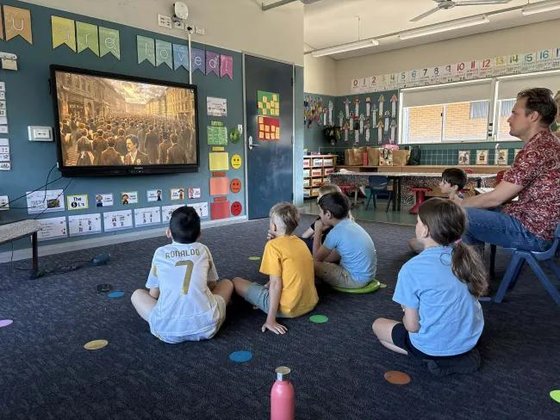
- Classrooms using culturally relevant media-based instruction reported a 45% increase in student engagement, with students spending 22% more time on the platform than assigned — continuing voluntarily after the homework requirement was met. (Roxxem internal data across 4,000+ districts)
Voluntary overtime is a direct behavioral proxy for the distinction in statistic 15, and the side of it streak mechanics do not reach.
How schools are responding
The numbers point at one consistent challenge: students need more contact with the language than scheduled instructional hours can provide, and the tools that generate the most usage are not the ones that generate the most commitment.
Districts are increasingly combining authentic cultural content, collaborative learning, classroom competition, and digital practice — and, more importantly, changing what they measure. Downloads and daily-active counts are easy to report and weakly predictive. Voluntary time beyond the assignment, voluntary sessions on non-school days, and voluntary consumption of target-language media outside the platform are harder to capture and far better indicators of whether a program is working.
Roxxem's engagement reporting is one of the few places this class of data is published at district scale. More of the sector should follow, because the conversion problem in statistic 12 is not going to improve until the industry starts optimizing for the thing that actually correlates with proficiency.
Key takeaways
- ✓ Access is uneven. One in five U.S. K-12 students studies a language, and fewer than half of public schools offer one at all.
- ✓ Reach is solved; conversion is not. 137.8 million monthly users, 12.5 million of them paying.
- ✓ Time-on-task is non-negotiable. No pedagogical innovation compresses 600 hours into 60.
- ✓ Motivation determines whether the hours happen. Learners who want to be in the language accumulate hours. Learners maintaining a streak accumulate streaks.
- ✓ Measure voluntary behavior. It is harder to report than completion rates and considerably more predictive.


