
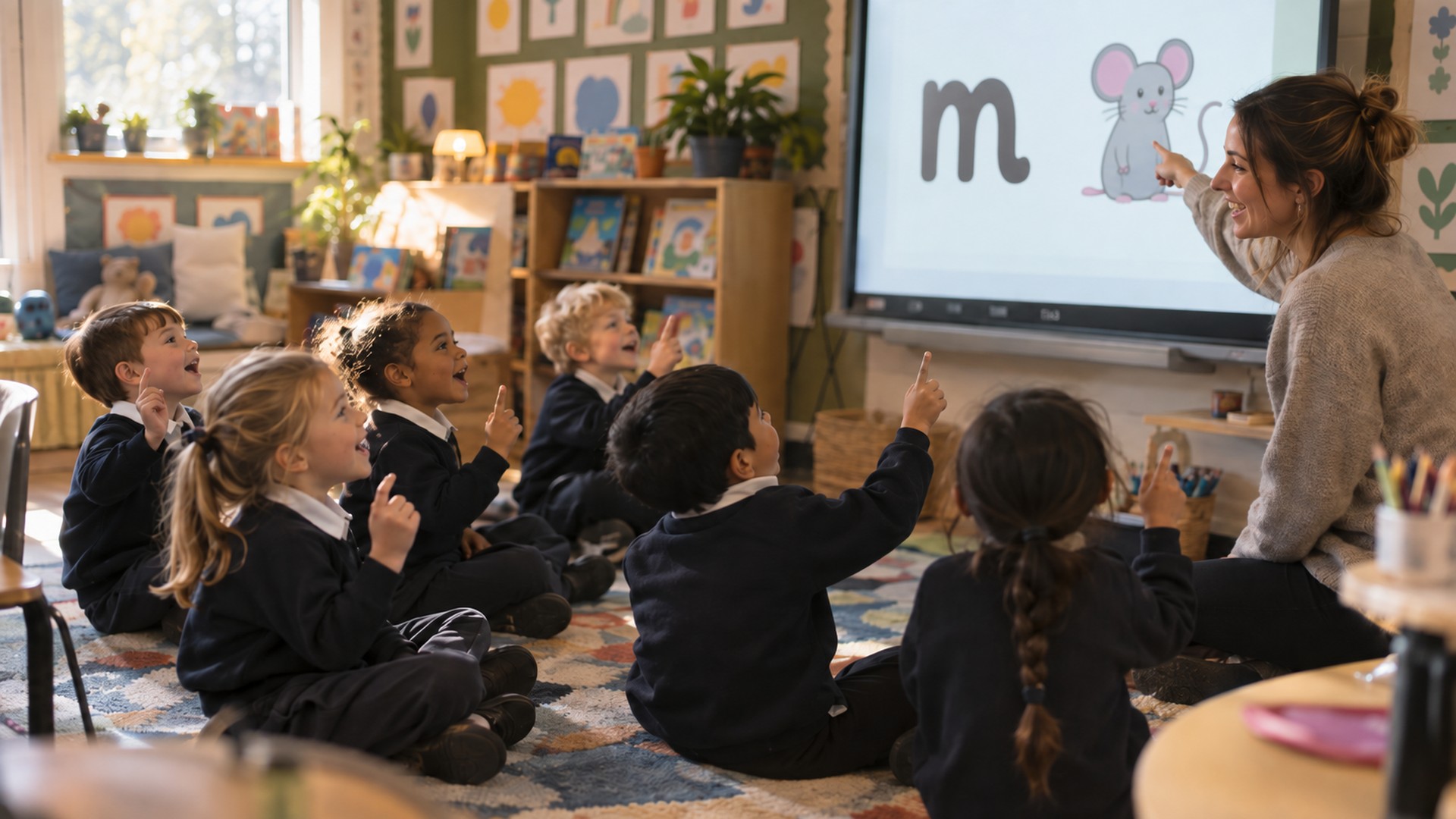
If you teach young children, you have probably seen how quickly they can learn a song. Play it a few times and before long they know what is coming next, they are joining in and you can hear them singing it later in the day.
That ability to remember through music can be really useful in phonics.
Why songs work well with phonics
Phonics involves plenty of repetition. Children need to hear a sound, say it, recognise the letter or letters that represent it and then use that knowledge when they read and write.
Songs are a simple way to build some of that repetition into a lesson without it feeling repetitive. Rhythm and melody give children a pattern to follow, and once they know the song they start anticipating what comes next and joining in more confidently.
Short videos can help too. Children can hear the sound while seeing the letter and examples of words that contain it. Keeping the visuals simple and closely linked to what children are hearing helps keep the focus on the learning.
For example, here’s a phonics song for the /z/ sound that uses music, repetition and visual cues to give children repeated practice with one target sound.
Children can use phonics songs to:
- ✓ hear and repeat the target sound
- ✓ recognise the letter or letters that represent it
- ✓ listen out for the sound in different words
- ✓ think of other words containing the sound
- ✓ join in with a familiar repeated pattern
Songs work particularly well alongside explicit phonics teaching. Once you have taught a sound, a song gives the class another way to rehearse it before moving on to blending, segmenting, reading and writing.
Taking the learning beyond the song
The song does not have to be the whole activity. Once the video finishes, you can keep the same sound going in several ways. Children might:
- build words with magnetic letters
- sort pictures or words according to whether they contain the sound
- look for the target letter or grapheme in a book
- practise blending and segmenting a few words
- write words containing the sound
You can also pause a video as you go. Stop before a word appears and ask children what they think is coming. Pause on a picture and ask them to say the word slowly and listen for the target sound.
Short songs are useful at different points in the day too. Use one after introducing a sound, as a quick recap the next morning or with a small group that needs more practice. Repeating the same song can help too, because familiarity gives children another chance to hear, say and recognise the sound.
A simple routine might be:
Teach the sound → sing it → practise it → use it.
You do not need to redesign your phonics lesson around a video. A short song can simply be one useful tool that helps children practise something you are already teaching.
Related reading
Effective Strategies to Teach English to Young Learners — games, visuals and other classroom approaches that work well with the same age group.
Written by Trisha Highton
Trisha Highton is a primary educator and contributor to Silly School Education, creating practical learning resources for young children.
References
- Ma et al. (2024), Q. J. Exp. Psychol., 77(2), 343–362. DOI: 10.1177/17470218231172494.
- Knott & Thaut (2018), Front. Educ., 3:31. DOI: 10.3389/feduc.2018.00031.
- Lawson-Adams et al. (2022), Early Child. Res. Q., 58, 87–102. DOI: 10.1016/j.ecresq.2021.06.008.
- Department for Education, England (2023), The Reading Framework.


